Spotting Wildlife in Costa Rica: Where & When (2026)
Sloths hanging above your pool, howler monkeys as an alarm clock at 4 am and macaws zooming over your apartment. Spotting wildlife in Costa Rica may well be the biggest reason to visit this country. In six weeks we saw hundreds of animals. But not everything: we never saw the famous quetzal. So we looked into where and when you can really see each animal best. That way you will have more luck than we did. A true ‘Let Us Stay For A Day’ recommendation…

This blog is also part of our 3 to 4 week Costa Rica itinerary.
Spotting wildlife in Costa Rica: the 7 golden rules
- Take a guide. Guides recognize animals by their sounds and also carry a spotting scope. In Cahuita, for example, our guide Eduardo spotted animals we would never have seen ourselves.
- Go early. Most wildlife in Costa Rica is active between sunrise and 9 am, and it is not yet crowded.
- Do a night tour. Much of the wildlife in Costa Rica comes out after dark: frogs, snakes, spiders and sloths are mostly seen at night.
- Look up and down. Sloths sit high in the tree, snakes lie on branches right next to the path.
- Touch nothing. Don’t grab plants or branches and stay on the path. The eyelash viper is venomous and perfectly camouflaged.
- Don’t feed animals. Not even the cheeky white-nosed coatis or monkeys.
- Choose responsible rescue centers. A good center never lets you hold a sloth or take a photo with one.
Where can you spot wildlife in Costa Rica?
1. Sloths
The star of Costa Rica. There are two species: the two-toed and the three-toed sloth. You can see them all year round.
- Best places: Cahuita National Park, Puerto Viejo, Manzanillo, Tortuguero, Manuel Antonio, La Fortuna, Uvita and Dominical.
- Less chance: in the dry northwest (Guanacaste and the Nicoya Peninsula).
- Our experience: we saw our first sloth at an Argentinian restaurant in Puerto Viejo. At our hotel Indalo a sloth with a baby hung above the pool for two days. A sloth that moves is rare, though: we saw one climbing in Manzanillo.

👉 Spotting sloths with a guide? These tours also score highly with other travelers:

2. Quetzal: the bird we missed
The quetzal is one of the most beautiful birds in the world: emerald green with a bright red belly and, in the male, a tail of up to 24 inches. We looked for it in Monteverde, but without a guide and a spotting scope we did not find it. Now we know why. Here is how to do better:
- Best place: San Gerardo de Dota, a mountain valley in the Talamanca Mountains. That is why this is the place: here you can see the quetzal almost all year. Los Quetzales National Park is also close by.
- Also good: the cloud forests of Monteverde, Santa Elena and Curi-Cancha, and the area around Poás and Bajos del Toro.
- Best period: the breeding season, roughly February through June. February to May is the most promising. Then they eat the little fruits of the wild avocado tree (aguacatillo) and are busy with their nest.
- Best time: early in the morning, or around the moment the male and female swap breeding duty.
- Tip: book an early bird tour with a guide with a spotting scope (often $51–103 per person). Also bring warm, waterproof clothing, because the cloud forest is cold and wet.
👉 Looking for the quetzal? Book a tour with a guide and spotting scope:

3. Hummingbirds
Costa Rica has more than 50 species of hummingbirds. So you see them almost everywhere there are flowers.
- Best place: Monteverde. At the Kolibri Café they fly back and forth constantly.
- Our experience: Claudia went hunting here with her telephoto lens. It took a lot of patience, but the photos turned out brilliant.

4. Toucans
You can see the keel-billed toucan, Swainson’s toucan and, in the mountains, the emerald toucanet.
- Best places: Puerto Viejo, Tortuguero, Sarapiquí, La Fortuna, Monteverde, Manuel Antonio, Uvita and the Osa Peninsula.
- Our experience: we searched for weeks. Only in Sámara did we finally see a toucan, and later in Manuel Antonio Claudia finally got a photo of one.

5. Macaws
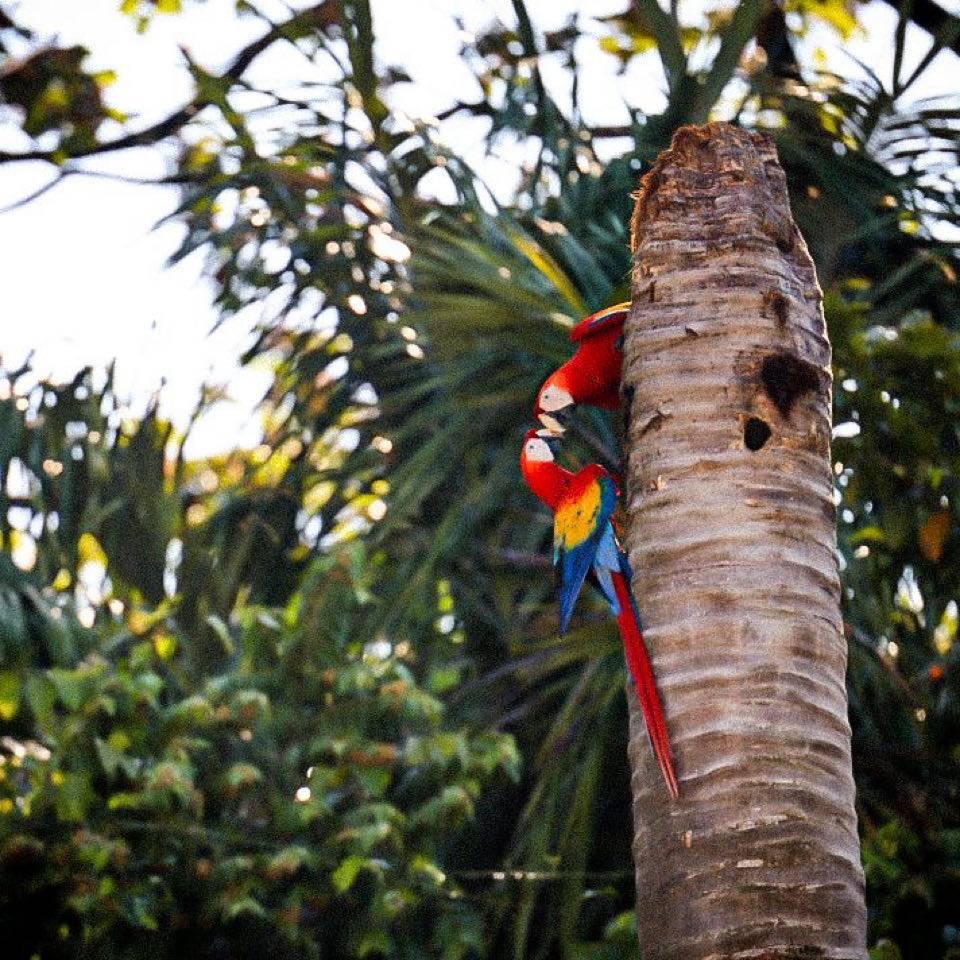
- Scarlet macaw: you see it mainly on the central and southern Pacific coast. Top spots: Carara National Park, the area around the Tárcoles River, Manuel Antonio and the Osa Peninsula (Corcovado, Drake Bay).
- Great green macaw: rare, because it only lives in the Caribbean lowlands. So your best chance is in Tortuguero, Sarapiquí and Boca Tapada.
- Our experience: in Manuel Antonio two macaws flew right over our apartment in the morning and landed in an old coconut palm. Then they posed for half an hour. What a gift!
👉 Spotting macaws with a guide in Carara or Manuel Antonio:

6. Monkeys
Costa Rica has four species of monkeys:
- Howler monkey: basically everywhere. You hear them before you see them. They woke us up at 4 am almost every morning.
- White-faced capuchin: also throughout the country. In Santa Teresa, for example, a whole group welcomed us at the Manala Hotel.
- Squirrel monkey: only on the southern Pacific coast, such as in Manuel Antonio and Corcovado.
- Spider monkey: on the Osa Peninsula, on the Caribbean coast and at Rincón de la Vieja, among others.

Tip: the Osa Peninsula (Corcovado) is the only place where you can see all four species.
👉 To Corcovado, where all four monkey species live:


7. Frogs
- Red-eyed tree frog: basically the symbol of Costa Rica, since you see it on every postcard. You mostly see it on night tours in La Fortuna, Puerto Viejo, Manuel Antonio and Monteverde.
- Poison dart frogs: small, brightly colored frogs, mainly on the Caribbean coast and on Osa. Also visible during the day, but don’t touch them.
- Tip: book a night tour ($46–68 per person). In Tortuguero we found it a bit disappointing; in the rainforests of La Fortuna and Monteverde they are often better.

👉 Spotting frogs and other nocturnal animals on a night tour:
8. Snakes
The best known is the eyelash viper, for example. Bright yellow, curled up on a branch, often at eye level.
- Best places: Cahuita National Park and the rest of the Caribbean coast, and the Osa Peninsula.
- Our experience: in Cahuita our guide pointed one out, a few yards from the path. We had simply walked right past it ourselves.

9. Sea turtles
- Green sea turtle: Tortuguero, from July through October. Only with a guide, at night.
- Leatherback turtle: on the Caribbean coast (Tortuguero, Gandoca-Manzanillo) in spring, and at Playa Grande near Tamarindo roughly from October through March.
- Olive ridley turtle: at Ostional, near Nosara. In the second half of the year thousands of turtles sometimes come ashore at once: the ‘arribada’. Ask local guides when the next one is expected.
- Important: keep your distance, don’t use a flash and don’t touch the turtles.
👉 Seeing sea turtles with a guide:
10. Whales and dolphins
- Best place: Marino Ballena National Park near Uvita, known for the ‘Whale Tail’.
- Humpback whales: come in two periods. From roughly July through October (from the south, with August and September as peak months) and from December through March (from the north).
- Dolphins: all year round, often on the same boat trips.
- Price: a whale tour in Uvita costs around $85–114 per person.
👉 Spotting whales and dolphins near Uvita:

11. Crocodiles and caimans
- Crocodiles: the best known spot is the ‘Crocodile Bridge’ over the Tárcoles River, on the road from San José to Jacó and Manuel Antonio. From the bridge you often see dozens of them. There are also crocodiles in the river near Tamarindo.
- Caimans: in Tortuguero we saw three during the morning safari.
👉 Spotting crocodiles and caimans by boat:
12. Other wildlife in Costa Rica
- White-nosed coati: especially common around Monteverde, Arenal and Manuel Antonio. But never feed them!
- Iguanas: everywhere. In Santa Teresa one even took a dive into our pool while we were swimming.
- Agouti: a large rodent, we saw one from our balcony in La Fortuna, for example.
- Tapir: rare, because it is mainly active at night. Your best chance is in Corcovado and around Tenorio and Río Celeste.
- Jaguar and other wild cats: very rare and also shy. You have a chance mainly in Corcovado and Tortuguero, but don’t count on it. Note: at the Jaguar Rescue Center near Puerto Viejo you will not see any jaguars or other wild cats, despite the name. You will see sloths, monkeys, birds and other rescued animals.

👉 To Río Celeste and Tenorio:
Spotting wildlife in Costa Rica: the calendar
| Animal | Best place | Best time |
|---|---|---|
| Sloth | Cahuita, Puerto Viejo, Manuel Antonio | All year |
| Quetzal | San Gerardo de Dota, Monteverde | February to June (peak Feb–May) |
| Hummingbirds | Monteverde | All year |
| Scarlet macaw | Carara, Manuel Antonio, Osa | All year |
| Monkeys (4 species) | Corcovado (Osa) | All year |
| Red-eyed tree frog | La Fortuna, Puerto Viejo (night tour) | All year, especially in the rainy season |
| Green sea turtle | Tortuguero | July to October |
| Leatherback turtle | Playa Grande / Caribbean coast | Oct–Mar / spring |
| Humpback whale | Uvita (Marino Ballena) | July–October and December–March |
| Crocodile | Tárcoles (Crocodile Bridge) | All year |
Frequently asked questions about spotting wildlife in Costa Rica
The Osa Peninsula with Corcovado National Park is known as the most biodiverse place. Easier to reach are Cahuita, Tortuguero, Manuel Antonio and La Fortuna.
The best place is San Gerardo de Dota, where the quetzal can be seen almost all year. The cloud forests of Monteverde also give you a good chance, especially from February through May. Go early and with a guide with a spotting scope.
In Tortuguero, green sea turtles lay their eggs from July through October. You can see leatherback turtles at Playa Grande roughly from October through March. At Ostional, thousands of olive ridley turtles sometimes come ashore at once in the second half of the year.
You can see humpback whales near Uvita from roughly July through October and from December through March. August and September are the best months.
You can see sloths all year round, especially in Cahuita National Park, Puerto Viejo, Manuel Antonio, Tortuguero and La Fortuna. You see fewer in the dry northwest.
Ready for spotting wildlife in Costa Rica?
In short: spotting wildlife in Costa Rica is pure magic. So take a guide, get up early and be patient. And did you see the quetzal? Send us a photo! Pura Vida!
Also read: Puerto Viejo, Cahuita and Tortuguero, Arenal and Monteverde, the Pacific coast and Costa Rica in 2 weeks.
Sources: our own experience (March–April 2026), SINAC, Visit Costa Rica and specialized travel and bird blogs. Seasons can differ from year to year, however.
On our website Let Us Stay For A Day we use affiliate links. These refer you to partners we work with.